Going Viral — and Recruiting 16,000 Research Volunteers
There’s a website called Zooniverse where you can volunteer to help researchers make sense of datasets. Once a user registers and chooses a project to work on, they spend their time looking through images and answer simple questions, like:
What shape is this galaxy?
What is this worm doing?
How many penguins can you see?
For researchers, the platform is a cheap way to turn raw data into useful information — and a good opportunity to connect with people outside their immediate scientific circles.
For volunteers (nearly 3 million people since 2009) motivations are a little harder to explain. The platform’s founder says they “want to play their part in today’s scientific discoveries and help to change the world they live in.” A huge percentage of Zooniverse’s activity comes from a small group of core users, which is also the case on similar platforms like Wikipedia and iNaturalist.
A few years ago, I did a story for WIRED on a Zooniverse project that was getting a lot of traction. Climatologist Ed Hawkins — famous in science communication circles for the “warming stripes” data visualization — was having a viral moment recruiting 16,000 volunteers to transcribe logs documenting rainfall in different locations across the British Empire from 1836 to 1960.
A few weeks ago, Hawkins published a paper about the colorful cast of characters who collected the original data. He also shared this graph showing the scale of the volunteers’ contribution to understanding Britain’s climate history.
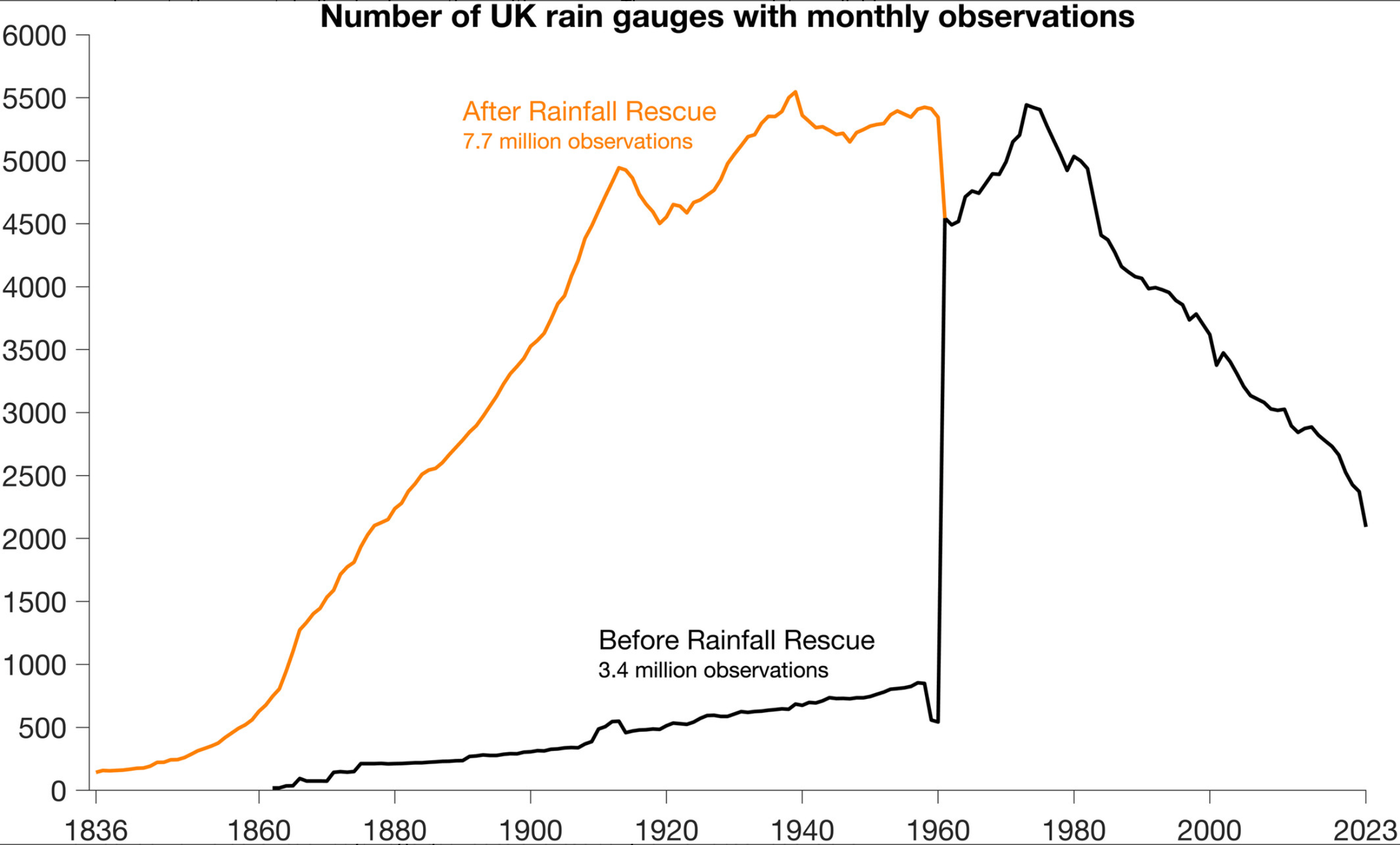
In a testament to the scale of the Zooniverse project, Hawkins reported in the 2025 paper that researchers now have more information about rainfall patterns in the 1880s than they do for the 2010s! And there is still plenty to do — a UK government office recently digitized nearly 400,000 additional rainfall sheets, which could contain 100 million new daily records.
Read the piece in WIRED: Citizen Scientists Digitized Centuries of Handwritten Rain Data